Home / Private label / Design studio
Design studio · Concept 01A case designed around the hinge
An in-house concept for AI glasses and compact camera hardware. The shell is ordinary; the thinking is where the hinge sits, where the window is, and what never touches a lens.
Why this product
Hardware is growing faster than its cases
AI glasses shipped about 4.2 million units in the first half of 2026, up 127% year on year (Omdia), with full-year forecasts near 23 million (IDC). Meta holds roughly three quarters of that market. The remaining quarter is a long tail of smaller brands — hardware companies that ship a $300–500 device with a pouch that was bought by the dozen.
That tail is where we work: short decision chains, low first quantities, and a product that needs to look like it belongs in the box.
The engineering problem
The hinge is under 3 mm across
A folded pair of AI glasses is about 150 × 55 × 45 mm. The hinge — the only thing holding each temple to the frame — sits at both ends of that envelope, exactly where most cases put their stiffest panel. One sideways knock in transit and the temples stop closing flush. The glasses still work. They just fit wrong, and the customer blames the glasses.
So this design starts at the ends, not the middle:
- Hinge relief. A 22 × 8 × 30 mm cavity at each end of the main compartment, and the stiffening board stops 25 mm short of it. The hinge never touches a hard face.
- Fleece only where it matters. Short-pile fleece on the floor and the lid. Non-woven sheds, and a shed fibre on a coated lens is a scratch you cannot polish out.
- Reverse-coil zip. Teeth face inward, so the zip cannot touch a temple while the case is closed.
- Two-tier interior. A 16 mm tray above the divider holds the cable and the cloth, with a web divider between them. The tray has hard walls, so pressure on the lid does not reach the charging connector.
Concept 01 · v2
The drawing
External 172 × 76 × 82 mm, about 1.07 litres — roughly 2.9× the volume of the folded glasses. That ratio is the cushioning and the stiffness; there is nothing in it to cut.
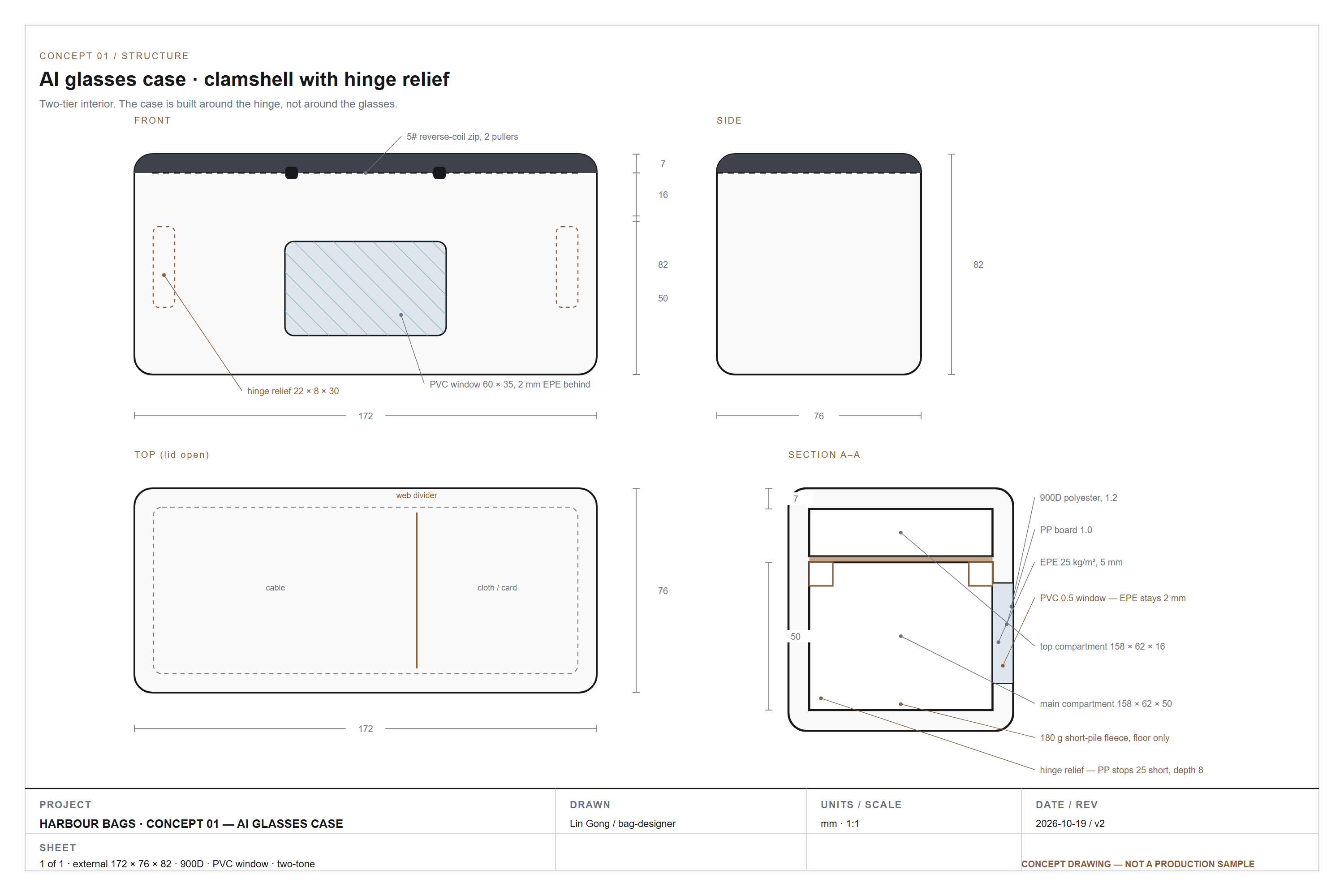
Concept drawing, 1:1 in mm. Not a production sample. Dimensions are based on current folded AI glasses and are re-cut per model.
The window
A window is a hole in your protection
Most requests for a see-through case come from marketing, and most factory answers quietly hollow out the padding to make the view clearer. That is exactly backwards. Four rules we build to:
- Position. The 60 × 35 mm window sits low on the front face, over the temples — never over the lenses, and never on the lid, which is the face that gets stacked on.
- Padding stays. A 2 mm EPE layer remains behind the 0.5 mm PVC. The view is marginally darker; the pressure path stays broken.
- Stitched, not welded. A bound stitch edge is slower than a high-frequency weld but stable at low volumes, where weld yields are not.
- Material. Standard PVC yellows in 18–24 months outdoors. For hardware brands we quote 0.5 mm PET instead — roughly 40% more on the window, no yellowing. Your call; both are in the BOM.
Specification
Concept 01 at a glance
| External | 172 × 76 × 82 mm, two-tone clamshell |
| Main compartment | 158 × 62 × 50 mm clear, fleece floor, hinge relief both ends |
| Top tray | 158 × 62 × 16 mm, web divider, fleece lid |
| Shell | 900D polyester, 1.0 mm PP stiffeners, 25 kg/m³ EPE, 210D lining |
| Window | 60 × 35 mm, 0.5 mm PVC (or PET), over a 2 mm EPE pad |
| Zip | 5# nylon reverse-coil, matte black pullers, three-sided opening |
| Colourways | Stock colours only for two-tone: charcoal / light grey, black / sand, forest / black |
Indicative specification. Everything is confirmed per order, and the insert is re-cut to your device's folded dimensions.
Send us your folded dimensions
Length × width × depth with the temples folded, plus where the charging port sits. We re-cut the insert and the hinge relief to your model, quote against it, and cut a first sample in 7–15 days.