Home / Private label / Design studio
Design studio · Concept 02A case the power station works from
An in-house concept for 6-7 kg portable power stations. The scenario it is built for is unglamorous: a campsite trunk where the case rides next to tent poles and a stove, and the unit has to run without ever leaving the bag.
Why this product
The heaviest accessory in the line, packed like a cable
Portable power stations have grown into the heaviest single item most outdoor brands ship as an accessory - 6 to 7 kilograms in a housing with a plastic shell, a display on the front and a carry handle on top. What usually comes with it is a soft padded bag.
That bag survives the drop test. The failure mode is the trunk: the case tips over, a stove or a tent pole slides into it, and every gram lands on one corner. Scratch, dent, and a display that reads wrong in daylight.
So this concept is decided by three questions: what happens when the case is stacked, how the unit is carried, and whether the customer ever needs to take the unit out to use it. The answer to the last one is no.
The engineering problem
The insert is cut smaller than the device
The die-cut EVA cavity is 246 × 166 mm for a 250 × 170 mm housing - 2 mm under the outline, per side. The foam compresses exactly that much and grips the shell of the unit. No slack means no migration inside the bag, and no secondary impact when the case tips over.
Two millimetres is the middle of the working band (1.5-3 mm per side). Denser foam takes the smaller number; this insert runs 45-50 kg/m³ EVA, stiff enough to hold 7 kg without fighting the pull-out.
- Handle pass-through. A 110 × 45 mm bound opening in the top panel lets the unit's own handle through - lift the case by the handle it already has, or grip it to pull the unit out.
- Display window. 90 × 40 mm, 0.5 mm PET, stitched over a 2 mm EPE pad. The view is marginally darker; the pressure path stays broken. Reading the state of charge never requires opening the case.
- Cable hatch. A 150 × 60 mm zip below the window opens to the output ports. Cables connect through it while the unit stays in its cavity - the insert has a matching cutout behind the hatch.
- Weight does not ride the zip. Two 25 mm nylon loops on the side walls anchor through the stiffened panels to a 1.0 mm PP floor board. Carrying it never loads the zipper.
Concept 02 · v1
The drawing
External 280 × 200 × 272 mm, about 15 litres around a 10-litre unit. That ratio is the cushioning and the stacking gap; there is nothing in it to cut.
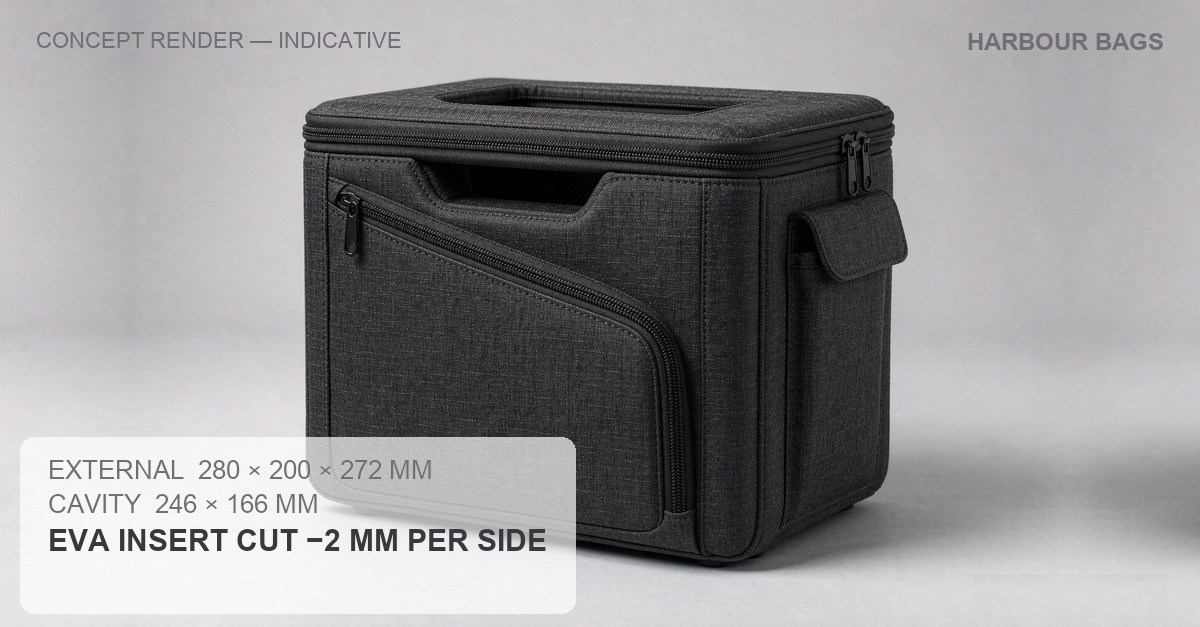
Concept drawing, 1:2 in mm. Not a production sample. Dimensions are based on current 6-7 kg portable power stations and are re-cut per model. Indicative.
The insert
Half-height tray, one-piece fold
The insert is die-cut from a single sheet of 10 mm EVA and folds on crease lines - no bonded corners, because a bonded corner is where a tray opens after its first hard landing. The tray runs 120 mm high, about half the internal height: below the centre of gravity, where tip-overs and drops actually land. Above it, the stiffened shell panels and a 5 mm EPE lid pad take over.
Two details that make 7 kg manageable: a 70 × 30 mm notch in the front wall gives fingers a place to start the pull, and the cavity opens behind the cable hatch, so the port face is reachable without disturbing the fit.
The insert is cut ±1.5 mm. The shell is cut ±3. Tolerances follow the job: the interference fit only works if the cavity is the one part that does not drift.
Specification
Concept 02 at a glance
| External | 280 × 200 × 272 mm, semi-rigid shell |
| Shell | 900D polyester with 3 mm EVA lamination, 210D lining |
| Insert | 10 mm EVA, 45-50 kg/m³, die-cut, 2 mm interference per side |
| Floor | 1.0 mm PP board, full panel |
| Handle pass-through | 110 × 45 mm, bound edge |
| Display window | 90 × 40 mm, 0.5 mm PET over 2 mm EPE |
| Cable hatch | 150 × 60 mm, 5# nylon zip |
| Main opening | Three-sided U, 8# nylon zip, water-repellent tape |
| Carry | Two 25 mm nylon loops, box-X anchored to the floor board |
Indicative specification. Everything is confirmed per order, and the insert, window and hatch are re-cut to your unit's dimensions.
Send us your housing dimensions
Length × width × height, which face carries the display, where the output ports sit, and the handle position. We re-cut the insert, the window and the hatch to your unit, quote against it, and cut a first sample in 7-15 days. Indicative; confirmed per order.